
From this separation it is possible to determine whether isocratic or gradient elution is the appropriate technique for a given sample and to estimate either the solvent strength for isocratic separations or the gradient range for gradient elution 583 588594. A typical system is outlined in Figure J-1.

Pdf Isocratic And Gradient Elution Chromatography A Comparison In Terms Of Speed Retention Reproducibility And Quantitation Semantic Scholar

Chemistry Net Gradient Elution In Liquid Chromatography
Hplc Isocratic Vs Gradient Elution Animated Youtube
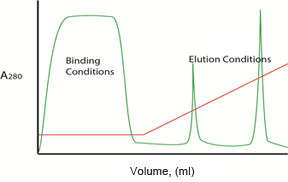
Linear gradients gradually raise the ionic strength and are ideal when starting with an unknown sample or if peak resolution is important.
Gradient elution chromatography. Chromatography Matrix with metal chelating group eg. The most common parameter for compound ID is its retention time the time it takes for that. Chromatography supplies and accessories.
Like many of the techniques on this site it is as much an art form as a science. After loading an impure protein sample onto an ion exchange chromatography column the column is washed to remove undesired proteins and other impurities and then the proteins of interest is eluted using either a salt gradient or a change in pH. 23 When running a gradient elution column use your initial solvent system until the.
Etc gas chromatography is a better separation technique. The SEC separation mechanism means that the elution volume or retention time is absolutely critical to the analysis. Traditionally this has involved column chromatography with a packed glass column involving solvent addition through the top of the column and gradual elution of the components in a steady solvent from through chromatographic interactions.
Proteins vary hugely in their properties and the different types of column chromatography allow you to exploit those differences. A semi-preparative twin-column recycling liquid chromatography TCRLC process was extended from isocratic to gradient elution mode. Isocratic LC System The second type is called gradient elution wherein as its name implies the mobile phase composition changes during the.
Gradient Elution 20. In this example for the separation of these neutral analytes approximately 17 x longer retention is obtained using methanolwater. In this mode the mobile phase either a pure solvent or a mixture remains the same throughout the run.
The underlying principles of gradient elution HPLC are very different from those of the isocratic mode. For those that choose to pack their own columns we have a wide selection of empty chromatography columns available. Acetonitrile has a higher elution strength than methanol for reversed-phase chromatography therefore shorter analyte retention can be expected for equal proportions of organic to water Figure 2.
The adsorbent a solid phase stationary. In analytical and organic chemistry elution is the process of extracting one material from another by washing with a solvent. Once the elution profile of the protein of interest has been established and it is known at what ionic strength or pH a protein elutes a step elution can be used to speed the purification process.
Appreciating the differences can lead to better methods. Thus two drawbacks to elution mode chromatography especially at the preparative scale are operational complexity due to gradient solvent pumping and low throughput due to low column loadings. In reversed-phase chromatography method development is often begun with a gradient elution separation.
Gradient elution is a term used in chromatography when here the mobile phase has a varying concentration. Page 12 The identification ID of individual compounds in the sample. Addition of salt increases the number of ions competing with proteins for functional groups on the stationary phase.
Binding of metal ions Cu 2 Ni 2 Zn 2 Co 2 Fe 2 Fe 3 Ca 2 2. To ensure the optimal functioning of chromatography columns and systems we provide cables pumps fraction collectors and other chromatography tools and accessories. Displacement chromatography has advantages over elution chromatography in that components are resolved into consecutive zones of pure substances rather than peaks.
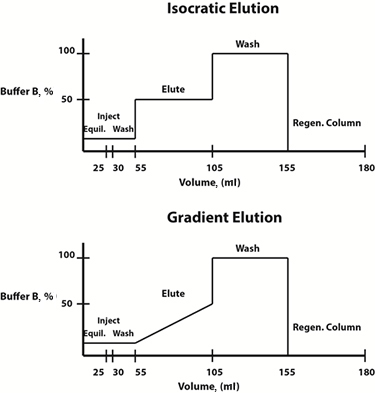
A decreasing pH gradient can be used to elute proteins using an anion exchange resin and an increasing pH gradient can be used to elute proteins from cation exchange resins. Often a gradient elution may be used to optimize elution conditions. Choice of elution method either linear gradient or a step elution affects selectivity.
Then a particular elution solution with decreasing salt gradient is then passed into the column that removes the bound molecules from the stationary phase. Proteins spend more time in the solution the rate of their movement down the column increases dramatically and proteins begin to elute from the column usually in order of increasing charge. The main separation challenge is when the sample mixture contains early nearly coeluting and late impurities all at the same time.
Once they are safely in your collection flasks you can begin to increase the polarity of the eluent. Protein can be eluted either in a linear gradient elution or using a step isocratic elution. High Performance Liquid Chromatography HPLC is a process of separating components in a liquid mixture.
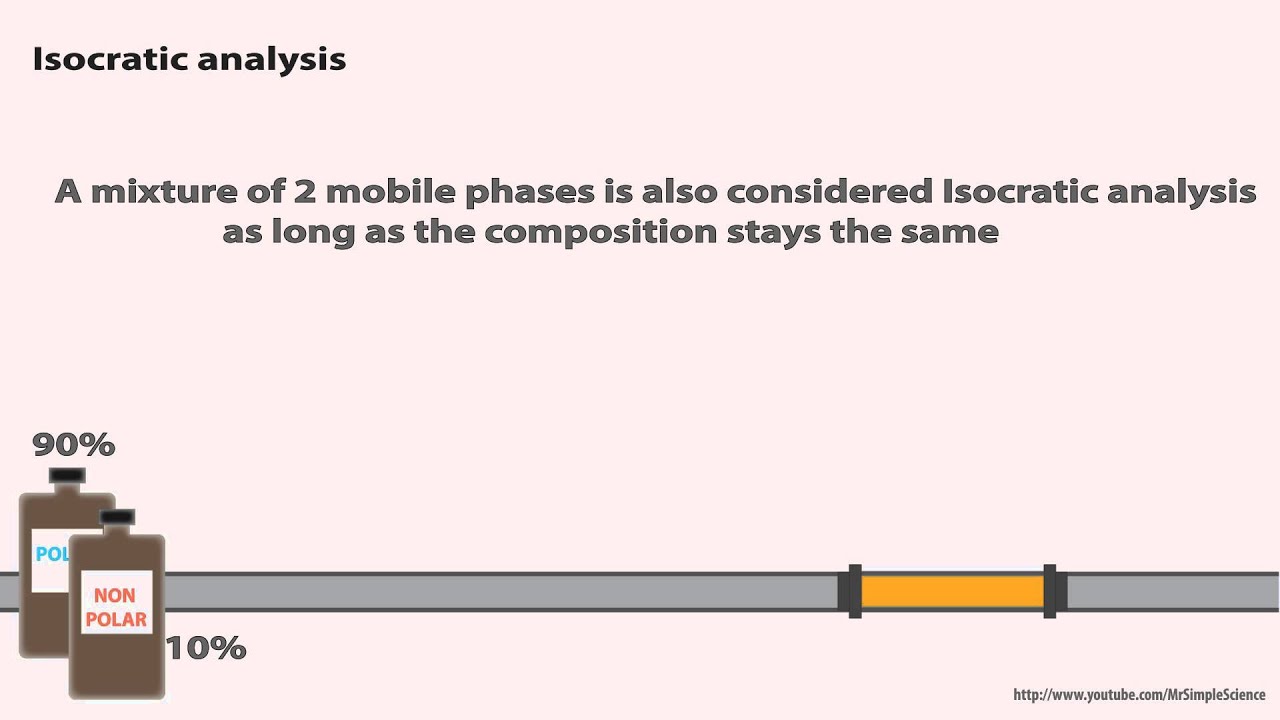
For example in HPLC a common separation method uses methanol 10 initially and ends at 90 by increasing the concentration gradually. As you know Chromatography is a process of the separation of molecules from a mixture. The first is called isocratic elution.
Known as gradient chromatography this is the technique of choice when a sample contains components of a wide range of polarities. In other words the concentration of the mobile phase does not have to remain constant. A liquid sample is injected into a stream of solvent mobile phase flowing through a column packed with a separation medium stationary phaseSample components separate from one another by a process of differential migration as they flow through the column.
Increase the polarity gradually. This requires high performance instrumentation to ensure precision and reproducibility. Loadingbinding of peptides to free coordination spaces of metal ion 3.
Isocratic high performance liquid chromatography HPLC for reversed-phase separations while being both convenient and robust in its nature has inherent issues especially when dealing with. Elution with salt gradient. Isocratic pumps or gradient pumps operated in isocratic mode.
Most of these methods do not require. In a liquid chromatography experiment for example an analyte is generally adsorbed or bound to an adsorbent in a liquid chromatography column. Column chromatography 2b planar chromatography and 2c.
Elution with Imidazole gradient Selection for His containing peptides Application for His peptides Cu 2 and. Chromatography Column chromatography is one of the most common methods of protein purification. This separation is done based on the differences in the samples adsorption coefficient or partition coefficient with the stationary phase.
Higher Rf compounds have come off the column. To progress the synthesis the product needs to be isolated in sufficient purity for the next step. Gradient elution processes exploit the fact that during the chromatographic process a modulation of certain operating parameters temperature pressure flow rate and composition of the mobile phase can improve the performance of conventional isocratic operation.
For a reverse phase gradient the solvent starts out relatively polar and slowly becomes more non-polar. Ion exchange chromatography is an interesting type of column chromatography. The gradient elution offers the most complete separation of the peaks without taking an inordinate amount of.
As in washing of loaded ion-exchange resins to remove captured ions. Also keep in mind that downstream techniques may be complicated by high salt concentrations or elution buffer pHs. Uses of Reverse-phase chromatography Reverse chromatography in combination with high-performance liquid chromatography is increasingly used for the separation of biomolecules.

Preparative Liquid Chromatography Primer Waters

Elution Chromatography An Overview Sciencedirect Topics
Liquid Chromatography Principles Bio Rad Laboratories

How To Choose Between Linear Gradients And Step Gradients For Flash Chromatography
Researchgate Net
Cation Exchange Chromatography Bio Rad Laboratories
1

Reversed Phase Hplc 19 Gradient Profile Youtube


